Stadiums as Catalysts: Designing Sports Venues That Revitalize Communities
For decades, stadiums were conceived as single-purpose facilities that came alive only on game days. Today, that model is no longer sufficient. Communities are increasingly recognizing that stadiums can, and should, serve as multi-functional civic assets that support economic development, social connectivity, and long-term community vitality. When planned intentionally, stadiums become true community hubs and catalysts for revitalization.
Collaboration Is Key
When considering stadium projects, it is important to approach the concept not as isolated buildings, but as integrated pieces of community infrastructure. From the earliest stages, active collaboration between municipal leadership, ownership groups, local stakeholders, and the design consultant is paramount to understanding the specific needs, aspirations, and constraints of the community. Engagement techniques could include public workshops, stakeholder meetings, community listening sessions, and coordination with municipal departments to identify gaps in recreational facilities, public gathering spaces, housing, and supporting infrastructure. These insights directly inform the design and programming of each project so that community priorities are embedded into the outcome rather than treated as afterthoughts.
Stadiums Should Function as Community Hubs
Venues should be designed to operate seven days a week and throughout the year, not only during scheduled events, remaining relevant and beneficial for decades to come. To accomplish this, designs should integrate community-focused spaces such as flexible meeting and event areas, food and beverage venues, and public-facing amenities that activate the site on non-event days. Multi-functionality is fundamental. Fields, concourses, clubs, and plazas can be designed to support a wide range of uses, including sports, concerts, festivals, meetings, and everyday community gatherings. The result is a facility that feels accessible, active, and valuable to residents regardless of whether a game is taking place.
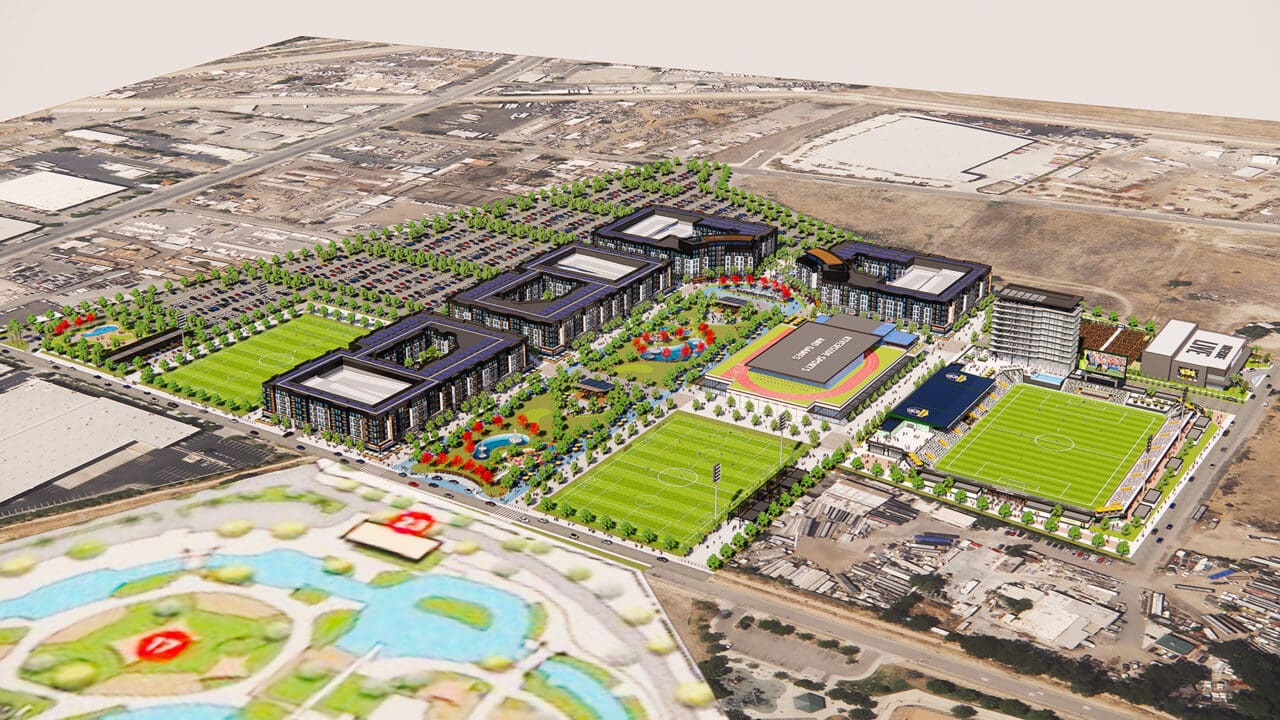
In Riverside, California, this approach is transforming a long-derelict floodplain site into a vibrant sports and entertainment district. In one coordinated effort, the project will deliver an active public park, athletic fields, a multi-sport stadium, a music and entertainment venue, and both below-market-rate and market-rate housing to address long-standing community needs. Equally important, the development incorporates infrastructure and environmental strategies that mitigate floodplain challenges and reduce downstream impacts. What was once an underutilized liability will become a resilient community asset that balances recreation, housing, entertainment, and environmental responsibility.
In Homestead, Florida, a stadium project extends well beyond sports to unlock a long-envisioned community park and recreational destination. The development will provide extensive sports and recreation infrastructure, including soccer fields, a rugby field, an American football field, baseball fields, tennis courts in both clay and hardcourt configurations, pickleball and padel courts, basketball courts, beach volleyball courts, playgrounds for children and toddlers, and a pump track. The multi-use stadium itself is designed as a central community hub, incorporating more than 12,000 square feet of fully equipped event space available to the city and community for meetings and public gatherings. The project also includes a world-class athletics academy serving up to 1,000 students, complete with learning facilities, performance centers, and the campus infrastructure required to support on-site boarding. Together, these elements create an integrated environment for education, athletics, and community life.
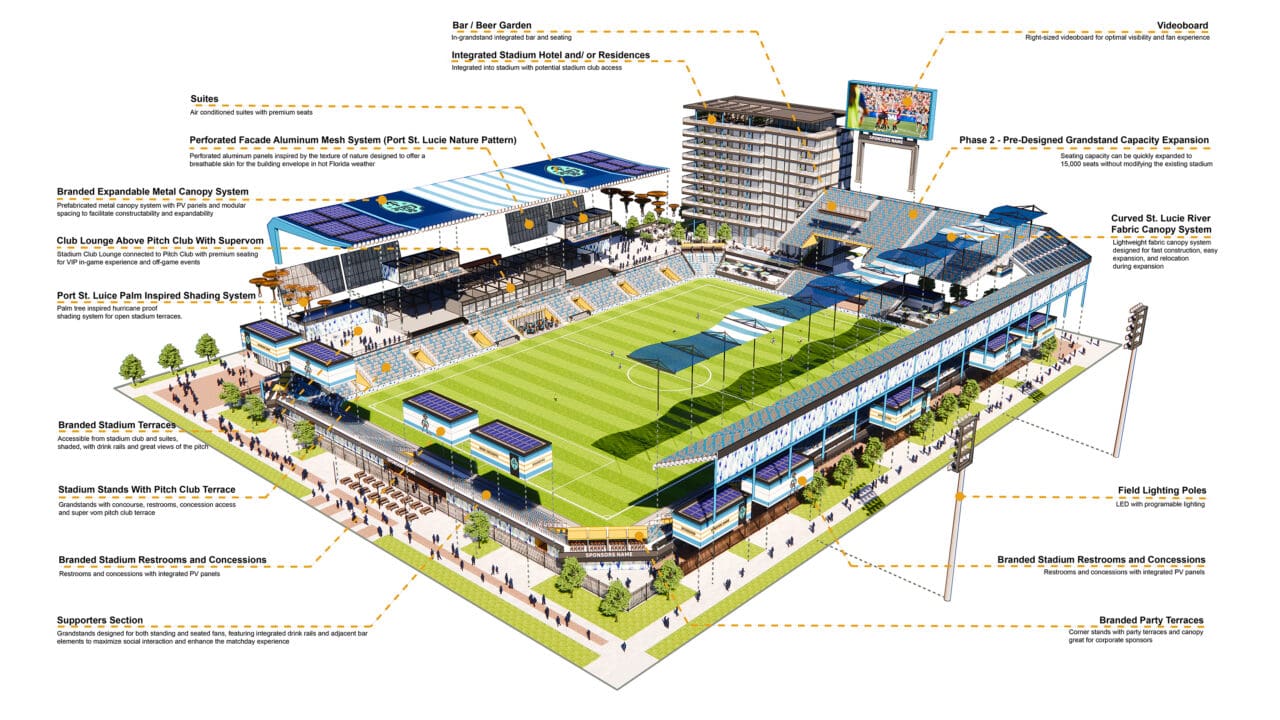
In Port St. Lucie, Florida, a stadium development is being delivered through a phased plan that aligns with a broader municipal parks and recreation initiative. The project is envisioned as a key contributor to a larger parks and recreation zone, with this development providing a substantial share of the athletic facilities, public amenities, and supporting infrastructure. By coordinating private investment with public planning, the project delivers immediate community benefits while establishing a scalable and financially responsible framework for long-term growth.
Plans Must Be Rooted in Reality
Across all of these project examples, feasibility and sustainability are essential. Conducting market analyses and feasibility studies helps municipalities, owners, and communities understand demand, operational viability, and long-term financial performance. These data-driven efforts ensure that projects are right-sized, economically sound, and capable of being sustained over time. For stadium-led developments to succeed, everyone must benefit. The municipality, the owner, and the community all need to see clear value for the project to endure. That balance only comes from a deep understanding of real needs supported by rigorous analysis.
Consider Alternative Approaches
Delivering these projects also requires a fundamentally different approach to design and construction. It is not about scaling down the strategies used for mega-projects. Instead, focus should be invested in research and development around materials, construction systems, and delivery methods that maximize design quality and user experience while responding to tight budgets, rising construction costs, and accelerated schedules. Solutions such as modular systems, hybrid construction approaches, and carefully coordinated phasing can efficiently deliver high-performing facilities without compromising ambition or community impact.
As municipalities continue to seek ways to enhance quality of life, attract investment, and create inclusive public spaces, stadiums present a unique opportunity. When designed as true community hubs and grounded in data, engagement, and innovation, they become long-term civic assets that deliver value far beyond game day.