Sanctuary Assisted Living Green House® Project

Canada’s First Green House® Project

In the low hills of Hamilton, Ontario, Canada, two floors of an unassuming 1960s, six-story brutalist building represent the very first Green House® Project (GHP) in Canada.

The design for the 18,250-square-foot renovation was a collaboration between LaBella Associates and Parker Architects for the owner, Silver Services. The team sought to design a home-like, person-centered care environment for seniors, reflective of the GHP model, which creates “radically non-institutional eldercare environments that empower the lives of people who live and work in them”.

With every detail carefully crafted, this renewed home environment now offers senior residents a place where they can truly flourish—today and for years to come.

The Green House® Project

Sanctuary Assisted Living is Canada’s first Green House® Project. According to their website, The Green House® Project is a non-profit organization founded on the belief that everyone has the right to age with dignity. They have helped 80 organizations, including Silver Services, build Green House homes. “A Green House home is a small-scale, self-contained, and self-sufficient community providing nursing home and assisted living care—with elders at the center of every decision. Homes include private rooms and bathrooms for each elder, a living room with a fireplace, a residential kitchen where meals are prepared fresh daily, and easily accessible outdoor spaces”.

A photograph of a dated exterior of a building in brutalist architectural style
Pre-renovation, a brick façade overlooked the courtyard.
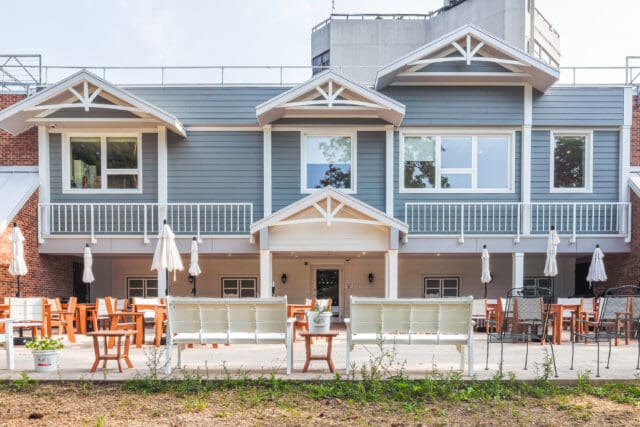
A photograph of an updated patio area outside of a assisted living facility with cottage-like details and patio furniture
Post-renovation, a refreshed courtyard is situated below a new façade reminiscent of the campus’ cottage architectural style.
A photograph of a bedroom with modern finishes and furnishings, looking to a living room
Two of the rooms are suites, with private living rooms and bedrooms.
A photograph of a living room with modern furnishings
Two of the rooms have private living rooms.
A photograph of an accessible bathroom with a toilet, handrail, and walk-in shower with bench
There are eleven resident rooms, each offering a bathroom with an enlarged, accessible walk-in shower, a built-in closet, storage, and space for visitors.
A photograph of a modern kitchen with white cabinets, stainless steel appliances, and blue island.
A large section of concrete wall was removed to open the dining room to the kitchen, which includes a breakfast nook and pantry.
A photograph of a dining room table set for nine people with a large chandelier above and looking to an entry foyer
A nursing station was relocated in favor of welcoming guests into the dining room, a space reminiscent of home.
A photograph of a modern living area with a fireplace, white and brown leather furnishings, and tasteful decor.
The main living room is centered around the hearth, which creates a warm setting.
A photograph of two individuals doing arts and crafts at a table.
Residents also have access to a small den for activities, a technology center, and a primary bathroom with a spa tub.
A photograph of a dining room table with a large chandelier above and looking to a living room
Careful coordination with the structural engineers was required to create open views between the den, living room, dining room, and kitchen.
A photograph of a utility room with laundry and a sink.
Tucked behind elevators, the storage room and laundry facilities are accessible from common spaces, but out of sight as to not detract from the home’s look and feel.
A photograph of a dated hallway in an assisted living facility with multiple doors.
The former eight-foot-wide corridor felt cold and institutional.
A photograph of an updated hallway of an assisted living facility with multiple doors
The corridor width was reduced at alternating locations, shortening sight lines and enhancing privacy in the bedroom wings.