Challenges
Poor Soil Conditions
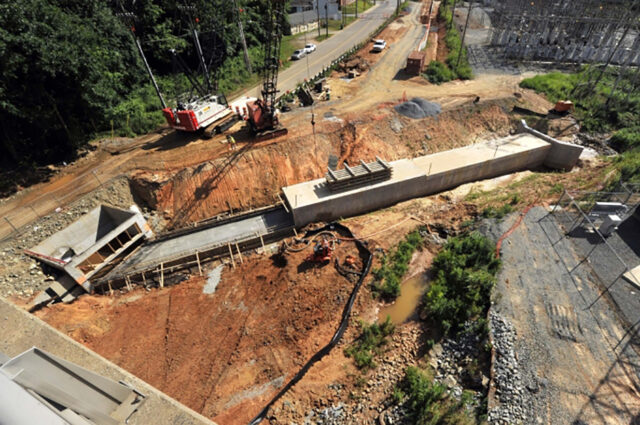
Geotechnical investigations revealed approximately 20 to 28 feet of alluvial soil. Even undercutting and replacing five feet of unsuitable soil would lead to long-term settlement of the proposed culvert. Though a more costly option, the most effective solution was a deep foundation design that would avoid excessive settlement.
Surrounded by Wetlands
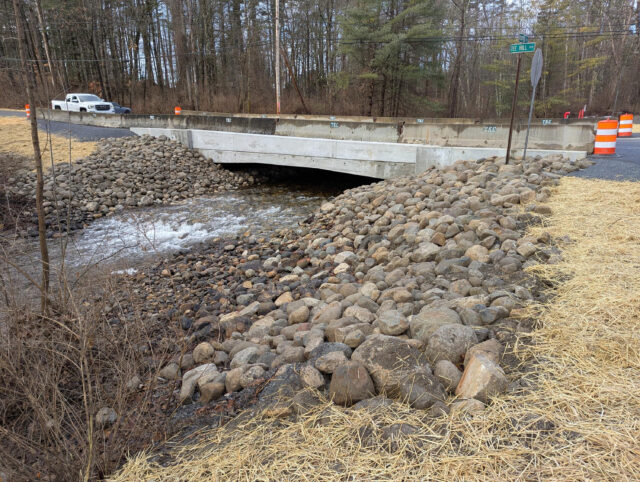
Bounded by several acres of wetlands on both the upstream and downstream side, preservation of the wetlands was a key driver of the design and construction process. Placing an impermeable dike in the wetlands was impractical. The materials and equipment could damage the fragile ecosystem and a dike would not cut off groundwater flow beneath it. The solution was a cofferdam of sheet piles, with the depth of the sheet piles set to effectively cut off the flow of groundwater. This allowed the culvert work area to be dewatered during construction without draining the wetlands.
To preserve the wetlands, the culvert design also included an upstream weir wall between the culvert wingwalls. The wall height was set to maintain the same elevation of the stream bed to avoid inadvertently draining the wetlands.
The box culvert has a sill at each end to keep one foot of soil in the culvert as needed to promote aquatic life passage and habitat.
Utility Conflicts
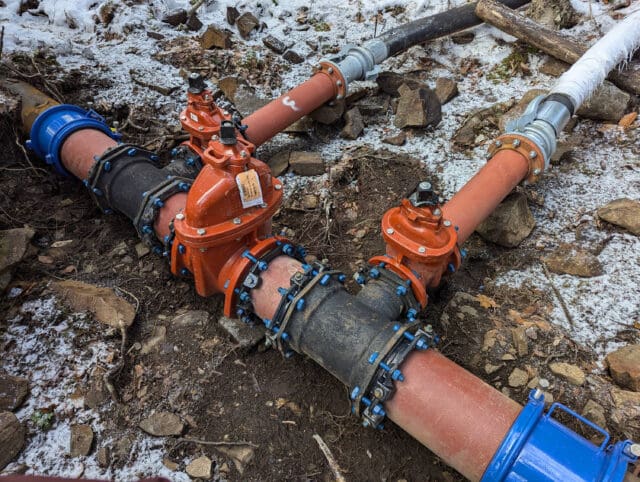
Another obstacle during construction was working around a six-inch steel gas main. The line could not be relocated or taken out of service, so pile spacing near the gas main was adjusted to provide more clearance and the foundation design was revised as needed. The project also involved the relocation of a 12-inch water main to allow the culvert to be installed.
Despite challenges around soil, wetlands, and other utilities, the project was completed ahead of schedule and under budget!
An Award-Winning Project
High Ridge Storm Drainage Improvement Project Named 2025 Stormwater Project of the Year by APWA North Carolina Chapter!
LaBella was honored to accompany Charlotte-Mecklenburg Storm Water Services in accepting the American Public Works Association (APWA) North Carolina Chapter 2025 Stormwater Project of the Year Award for the High Ridge Storm Drainage Improvement Project.
The project and project team were recognized at the APWA North Carolina Chapter’s 2025 Stormwater Management Conference held September 28-30, 2025, in Asheville, North Carolina.
The Stormwater Project of the Year Award celebrates projects which promote excellence in the implementation of stormwater projects in North Carolina by recognizing the alliances between project owners, consultants, suppliers, and contractors that result in successful stormwater management improvement projects.