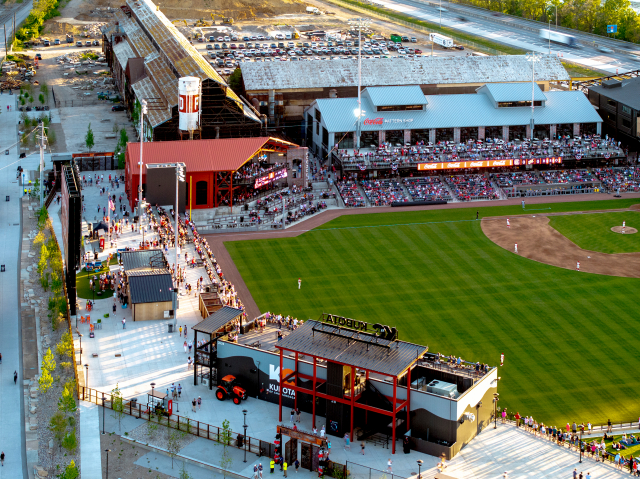
“With an abundance of social experiences, family-friendly spaces, and the Tennessee Riverwalk greenway running through the venue, there is something for everyone at Erlanger Park.” (Erlanger Park)
From Early Planning Through Design & Construction
Master Plan
A comprehensive master plan was developed for approximately 131 acres, including the former US Pipe, Wheland Foundry, and Gateway View sites. The plan provided the framework for development programs, sustainability strategies, and key initiative areas and outlined a mixed-use development which established an urban design framework with blocks, streets, parking, open space, and both commercial and residential uses.
Site Preparation/Land Development
As a brownfield site, preparing the area to be pad-ready for Erlanger Park was a tremendous undertaking managed by LaBella.
The team began by preparing a utility and topographic survey of the entire parcel.
Working with teaming partners, LaBella’s civil engineers, environmental scientists, and landscape architects determined the site layout, grading, drainage, and utility services for the new ballpark and surrounding master development.
The grading design and excavation permitting plans developed were a major step in preparing the site, particularly given the site’s industrial past. The design involved iterative earthwork quantity takeoffs and plans to determine the most efficient grading approach. This phase of work required coordination between several disciplines, including civil, environmental, and geotechnical services for the brownfield site.
Working with the owners, LaBella determined the most beneficial stockpile locations that would limit construction traffic, minimize material haul-off, and meet the requirements of the Brownfield Agreement and Soil Management Plan.
During excavation, LaBella provided construction administration and support and coordinated with the construction manager and contractors on project changes due to unforeseen conditions. The team also provided construction phase services for the excavation, including civil site observation on behalf of the owner and environmental services for handling the foundry sand. See Environmental for more details.
Additionally, LaBella’s engineers permitted an excess land application with the Tennessee Department of Transportation to acquire an Interstate 24 right-of-way to facilitate development along with designing the relocation of the Intelligent Transportation System equipment and infrastructure.
Environmental
LaBella’s environmental team provided onsite observation during excavation to document implementation of the Tennessee Department of Environment & Conservation (TDEC) Soil Management Plan.
When material not previously identified was encountered, LaBella worked with the contractor to promptly segregate the material for characterization so as not to hinder the project schedule. If testing identified volatile organic compounds in the material, LaBella worked with the owner, contractor, and TDEC to characterize the material in place, gain approval for the material to remain, and develop an approved vapor mitigation design.
The team also supported regulatory coordination and prepared the Soil Management Plan required as a part of transferring the Gateway View Landfill, a former closed foundry sand landfill regulated under the Division of Solid Waste, to the Division of Remediation. The transfer allows reuse of the former landfill for disposal of foundry sand waste material excavated from the former US Pipe site and ultimately as an improved redeveloped site.
Where certain soils are not suitable for disposal at the former Gateway Landfill, LaBella characterized and permitted them for off-site disposal as Special Waste.
Geotechnical
LaBella’s geotechnical engineers developed specifications for an alternative stabilized working surface using recycled concrete aggregate suitable to withstand vertical equipment construction loads to reuse concrete removed from the site. The team also performed construction materials testing during construction.
Groundwater
Initially, LaBella’s civil and environmental teams provided guidance and recommendations on methods to remove groundwater from the stadium area. Upon further consideration, the stadium elevation was raised to avoid potential exposure to contaminated groundwater at the field and subfield levels.
Stormwater
LaBella’s engineers designed a storm sewer collection system for the stands, dugouts, bullpen areas, and entire concourse. These areas, along with the field drainage, connect to a new, dedicated storm sewer system that ultimately discharges to the Tennessee River via a new 42-inch coated steel pipe installed by jack and bore underneath Interstate 24.
Traffic
As part of the stadium and adjacent residential development, LaBella’s traffic engineers prepared a Traffic Impact Statement, which documented the potential impact on surrounding public infrastructure during various phases of build-out, as well as the Traffic Improvement and Event Management Plans to help mitigate those impacts.
Landscape Architecture
The goal for the stadium district landscape was to achieve 100% reuse of on-site materials as foundational elements creating a post-industrial landscape unique to Chattanooga and traditional ballpark sites.
The process started with a salvage protocol to inventory materials and identify reuse potential of the former Foundry building and site features. With building blocks of salvaged concrete, brick, and steel, a thoughtful design was developed to integrate old and new, creating an intentional uniqueness for the landscape. For example, instead of using an aluminum and chain link fence, the design incorporated perforated Corten steel gates and fencing panels commissioned by an artist to serve as the ballpark perimeter.
The Tennessee Riverwalk also extends through the site, welcoming both stadium goers and Riverwalk users for generations to come.
In partnership with landscape architects Ten x Ten and D.I.R.T. Studio, Ten x Ten and D.I.R.T. Studio, LaBella served as the production landscape architects responsible for the development of construction documents and administration and oversight of the landscape installation.
80% Reduction in Total Suspended Solids
Adding pervious surfaces, such as lawn and landscaping, significantly reduced impervious areas across the site.
LaBella’s analysis of total suspended solids loading showed that the newly developed site achieves more than an 80% reduction compared to the former industrial site, meeting the City’s water quality requirements.
The Evolution of Erlanger Park


Time-lapse Video
Watch Erlanger Park Take Shape
Watch the transformation of Erlanger Park, from a former industrial brownfield site into a world-class stadium district and the new home of the Chattanooga Lookouts. This time-lapse captures the incredible redevelopment effort that blended historic preservation, sustainable design, and modern construction to create a vibrant community destination along the Tennessee River.
Opening Day
Located along the Tennessee River between the two most visited attractions in Chattanooga—the Downtown Aquarium and Lookout Mountain—Erlanger Park is now an anchor for the revitalization of South Chattanooga and a new gateway to the City. It’s 360-degree, wraparound concourse offers distinct experiences and vantage points throughout, highlighted by two buildings preserved from the former US Pipe site: the Pattern Shop and the Powerhouse.
Erlanger Park celebrated its opening day with the first pitch on April 14, 2026.
Pictured: Pipe Properties/Perimeter Properties Partner Andrew Stone, PE, with the LaBella project team


Featured Press
Erlanger Park has been widely featured in the media during construction.