From First Steps to the Final Bell: Choose Flooring That Lasts

Cleaning and maintaining flooring often comprise a large portion of a building’s operational budget, and it’s common for building maintenance teams to have strong preferences regarding flooring types and their performance.
During any expansion or renovation project, districts will need to discuss their preferences for flooring finishes with the design team. Each option comes with tradeoffs, and manufacturers continually refine products to improve performance. That said, there is no perfect flooring material. If it’s been several years since your last flooring selection, it’s worth revisiting current options and conducting due diligence.
Your project’s interior designer can serve as a trusted advisor throughout this process. They work closely with manufacturers and installers and are knowledgeable about products being introduced and discontinued. Some may even visit the facilities where flooring is manufactured to gain deeper insight into the composition and characteristics of each flooring type. Experienced designers have specified millions of square feet of flooring material, possess detailed knowledge of subfloor conditions that may disqualify certain materials, and maintain a network of references to keep tabs on long-term performance.
Interior designers love to educate clients on their options. Below are a few “golden rules” for our favorite students—school districts!
Bring in the Math Teachers
In other words, don’t skip the calculations that determine the true cost of ownership. One of the most common K-12 floor finishes remains vinyl composition tile (VCT) because it is the most economical commercial flooring option available. However, it also has one of the most expensive costs of ownership, as its maintenance requirements (waxing, stripping, polishing) are frequent and labor-intensive. While alternatives may be double or triple the initial cost of VCT, no-wax floors will typically offset their higher price point within a reasonable ownership period. It’s worth running the numbers.
Inside Voices, Please
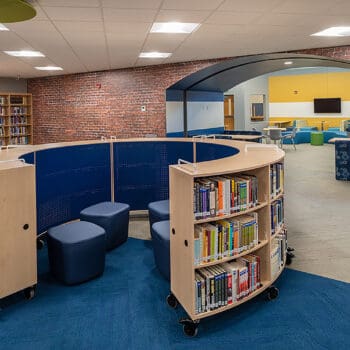
Studies show that poor acoustic environments impact information retention and behavioral outcomes. Flooring, ceilings, and walls all impact acoustics, but if you choose a hard surface for classroom flooring, your wall and ceiling finishes will need to work even harder. Most hard surface options will not provide any meaningful control for voices, though some materials like rubber, linoleum, or flooring with cork components can help reduce foot or impact noise (like a dropped metal water bottle) that could travel floor-to-floor. If you’ve sworn off broadloom carpet, you may want to reevaluate carpet tile for its noise absorption and easy replaceability, especially in offices, libraries, music spaces, or primary classrooms.
Watch Out for Subfloor Grade Inflation
An impartial assessment of subfloor condition is essential to determine the success of your flooring finishes. Uneven or cracked subfloors present challenges. A thick, brittle finish like VCT will hide texture issues but will crack if forced to span unlevel surfaces. Finishes with more flexibility, such as solid vinyl tile or rubber, will not crack but may allow underlying conditions to “telegraph” through the material and be visible at the surface. Floor prep is as important as test prep—designers, manufacturer reps, and contractors should work together to ensure the slab meets moisture requirements and that an appropriate underlayment is selected where necessary.
Knowledge Is Power
Most flooring issues are the result of maintenance staff being uneducated on the nuances of a specific product’s maintenance. If you’re considering a product that is new to your campus, don’t hesitate to request a site visit to see the material installed at another school or solicit references who will speak to you about their experience maintaining the finish. If time allows, some manufacturers are willing to provide enough material for a mockup installation, and pilot classrooms can also be coordinated to gather feedback from end users.
Sometimes Copying Is Okay
Terrazzo, a composite material made by mixing marble, glass, or quartz chips with an epoxy or cement binder, seems to be one type of flooring that nearly everyone can agree on, thanks to its longevity, simple maintenance, and customizable aesthetics. Unfortunately, its cost per square foot is out of reach for many projects. There are several new products that offer terrazzo visuals at a lower price point, including vinyl, rubber, and epoxy. This can allow districts to be very selective in their investment in terrazzo—prioritizing lobbies, cafeterias, and corridors—and then using terrazzo look-alikes in other areas. Bid alternates can support this strategy by letting real prices maximize terrazzo extents.
It’s Time for a Group Project
Your new floors need to work with your furniture. Glides on the bottom of furniture that gets moved frequently, like desks and chairs, can be a major source of floor finish wear. If your project calls for selecting both flooring and furniture, it can be helpful to have both conversations at the same time.
Selecting the right flooring for a school environment is ultimately a balance of performance, cost, maintenance, and user experience. By taking a long-term view, engaging knowledgeable design professionals, and involving key stakeholders—from maintenance staff to educators—districts can make informed decisions that support both building operations and student success. Thoughtful planning, careful evaluation, and a willingness to explore new options will help ensure that flooring investments deliver lasting value for years to come.

About the Author
Insights by Danielle Lewis, CID, ALEP, IIDA, WELL AP: