The School Nurse’s Office: No Longer Just Ice Packs and Bandages

The old perception is that the school nurse hands out ice packs and bandages in a modest-sized room set up with cots and curtains. However, as student health needs gain in complexity, school health services have become more comprehensive. Today, school nurses are delivering a level of care that far exceeds history, and they need office space to support it.
Evolution in Needs
In 1997, “Schools & Health: Our Nation’s Investment” described a comprehensive school health approach as “a broad spectrum of activities and services which take place in schools and their surrounding communities that enable children and youth to enhance their health, develop to their fullest potential and establish productive and satisfying relationships in their present and future lives.”
Despite dating back nearly three decades, that description fits the role of today’s school health services well. School nursing has played an increasingly integral role in providing the comprehensive school health services that exist today.
I spoke with Jacqueline Dennison, DNP, RN, PPCNP-BC, Medical Director at Gates Chili Central School District in Monroe County, New York, who reported a significant increase in long-term and complex medical needs across all age groups. These include physical, mental, social, and emotional needs that impact a student’s school day and education.
They must be met—and exceeded. Additional services like laundry and showers are becoming more common in the nurse’s office. “Years ago, the school was just an adjunct to home life. Now, we supplement as much as we can for what is lacking in a student’s home life,” Dennison explained.
Role of Today’s School Nurse
“Today, it’s a whole new approach for school nursing that is much more complex, involving collaboration between staff, community services, and families,” Dennison continued.
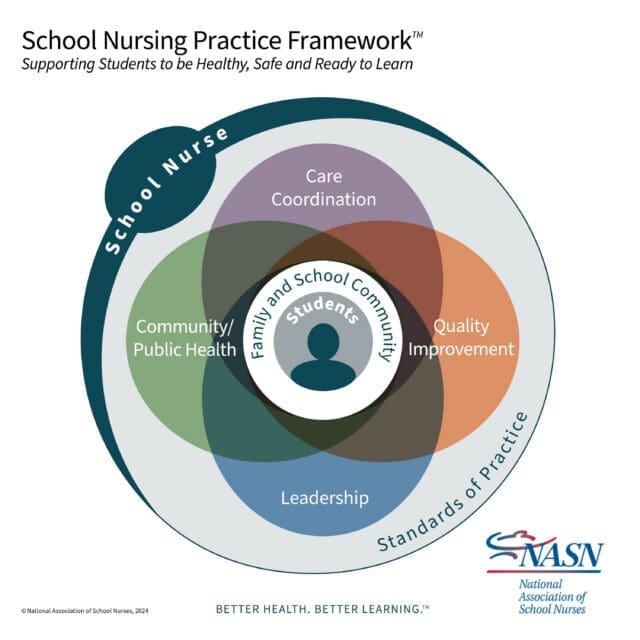
In addition to providing or securing accommodations for the needs described earlier, school nurses are working within a comprehensive student care team comprised of school therapists for physical and occupational needs as well as speech therapy, guidance counselors, and social workers. They’re integrating families and community programs into care. It’s a holistic approach that goes far beyond ice packs and bandages.
Nurse’s Office of Yesteryear
The nurse’s office of a decade ago is generally too small to support today’s complex needs and team approach. It is often located in a space not planned or designed for more complex healthcare needs. In most cases, there is little-to-no room for accessibility or the privacy needed to maintain comfort and confidentiality. With less attention paid to aesthetics and the emotional response to finishes, dated spaces can feel uninviting and institutional.
Fact-Finding
Before addressing challenges like space, privacy, and finishes, designers should have in-depth conversations with school district leaders, medical directors, nurses, and students, asking questions such as: What does a school nurse’s day look like? What tools do you need to support your work? How much equipment do you have? How much storage do you need? How often do you receive deliveries?
The most effective approach to an integrated design starts with seeking input from the end users. From ADA-accessible bathrooms and showers to refrigeration and laundry, designers should consider every detail that will support school nurses’ needs and enhance their ability to provide quality care. Dennison also suggests, “Incorporating nurses’ input will better capture what students will respond to.”
The Design Response
Design elements can improve how today’s nurse’s offices respond to new and evolving student needs. They must support a welcoming, healing environment while maintaining privacy, accessibility, and infection control. Since few districts have the resources to build a brand-new nurse’s office, all of this must be achieved within an existing site footprint.
Location
The school nurse’s office must be located in a place that meets functional and student needs. There is a psychology to it. For example, a location close to the school’s main office might intimidate a student. A welcoming entry point and appropriately scaled design elements can not only improve access but also reduce anxieties.
Generally, a location near the front of the school with a separate access point is ideal. With the appropriate security controls in place, students and parents can enter directly into the office. This approach improves efficiency for external parties such as EMS personnel, enhances perceived safety for students, and supports confidentiality. Clear wayfinding signage can further improve efficiency for external parties.
Additionally, some schools are trending toward health wings/hubs—centralized locations that group nursing, counseling, and other key support services.
Finishes
Finish details in school nurses’ offices must support infection control and longevity. Durability, antimicrobial properties, and the ability to withstand cleaning and caustic materials should be prioritized.
New technology uses copper embedded into high-touch surfaces, such as doorknobs and chair armrests, because of its self-sanitizing properties. Paint manufacturers are producing solutions that include bacteria-killing additives, such as silver, copper, or zinc ions, that can be considered in these areas.
Seamless floor systems with an integrated cove base can limit areas for dirt and germs to build up. These flooring solutions are also resilient to high traffic and high wear and ensure a sound investment for longer lifecycle costs analysis.
All selected finishes should have smooth surfaces to accommodate assistive devices and be amenable to anti-bacterial cleaning agents.
Infrastructure
Full space reconfiguration may allow for new building infrastructure, such as plumbing and electric, and provide opportunities to add support services, increase accessibility, and improve privacy and care. Working with existing infrastructure has its challenges, particularly when adding new elements. For example, adding a shower may require an increased water supply. Trade-offs may be necessary to reprioritize the necessary square footage to accommodate these facilities.
Aesthetic
A healing environment is critical for an effective school nurse’s office, especially if its location can deter students. In general, soft and muted natural tones and biophilic design create a soothing environment.
A window goes a long way—views to the exterior can be calming, while natural light brings in warmth. Other lighting should be zoned and dimmable to accommodate different needs, such as task lighting over a desk and dimmable lighting over a cot.
Artwork featuring nature or a natural color palette can draw attention away from medical equipment, improving the overall experience by reducing stress.
Designing for Student-Centered Healing
When asked what will make the greatest long-term impact on how the school nurse’s office serves its students, Dennison replied, “Creating private, accessible spaces that support confidentiality, comfort, and the equipment needed to serve students of all needs.”
The room with a few cots separated by curtains is advancing to meet the long-term and complex medical, physical, mental, social, and emotional needs of students. Accommodating these needs is a basic building block to support comprehensive school health services. When school nurses are part of a holistic health team and can serve students from a safe, calming environment designed for its true—and evolving—purpose, students receive the care that supports their academic success.