MUSC – Schiller Surgical Innovation Center
Designing the Next Generation of Surgical Advancement
The Schiller Surgical Innovation Center at the Medical University of South Carolina (MUSC) transforms the fourth floor of the Clinical Sciences Building into a dynamic environment dedicated to advancing surgical techniques, technology, and interdisciplinary collaboration.
Through the renovation and reconfiguration of approximately 4,500 sq. ft., the project establishes a modern hub where surgeons, researchers, and innovators work side-by-side to explore new applications in surgical care. Central to the design are five collaborative team labs, including enhanced 3D printing areas that support hands-on training, rapid prototyping, and research initiatives. These spaces are intentionally designed to accelerate innovation from concept development to clinical implementation.
Feasibility Study
LaBella initiated the project with a comprehensive feasibility study to evaluate the potential of the existing fourth-floor space within the Clinical Sciences Building. This phase included assessing spatial constraints, infrastructure capacity, and programmatic requirements to ensure the vision could be effectively realized within the existing building footprint. The study established a strategic framework, aligning the Center’s goals with practical design and construction considerations.
Planning & Design
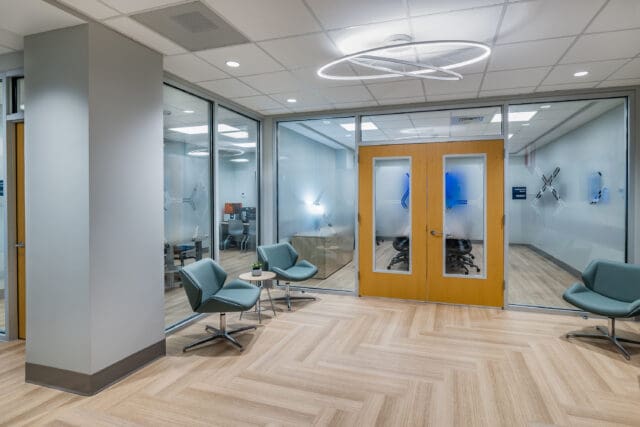
Building on the feasibility findings, LaBella led the planning and design process to reconfigure the underutilized office space into a highly functional and adaptable environment. The redesigned floor plan introduces a thoughtful mix of conference rooms, open collaboration areas, private offices, and flexible workstations. The design integrates new partitions, doors, frames, and electrical modifications, ensuring the building’s infrastructure supports the Center’s specialized needs.
Construction Administration
LaBella provided construction administration services, helping maintain design intent, coordinating with contractors, and addressing field conditions efficiently. Oversight included monitoring the installation of architectural elements and electrical upgrades, reviewing submittals, and facilitating communication among stakeholders to ensure the project fulfilled quality standards, budget, and schedule objectives.
By reshaping underutilized office space into a forward-thinking innovation center, the project strengthens MUSC’s commitment to cutting-edge surgical advancement and interdisciplinary medical education, providing a platform where ideas move seamlessly from research to real-world impact.